
One. What is "Daily Porcelain"?
Daily porcelain is a type of porcelain commonly used in everyday life, and it comes in a variety of forms:
1、Purple clay pottery
Purple clay pottery originated in the Song Dynasty and flourished in the Ming Dynasty. It is made from high-iron purple clay. Due to the characteristics of fine texture, strong plasticity, high bonding strength, low shrinkage (less than 2%), and small deformation of purple clay, the products have neat and refined shapes. It is often used to make medium and small household and decorative items, such as single teapots, tea sets, vases, flower pots, and shallow bowls.
2、Jingtao
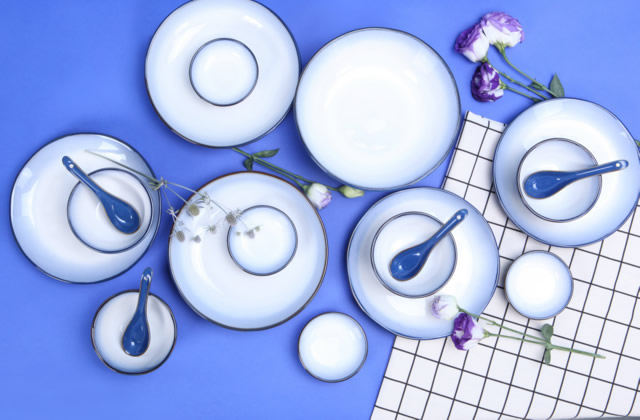
Ceramic products are classified according to the quality of their bodies into coarse ceramics and fine ceramics. Fine ceramics are characterized by their exquisite workmanship, regular shapes, thin bodies, and smooth, glossy glazes with elegant decorations. Fine ceramics can be produced into sets of tableware and teaware, or designed and manufactured as decorative items.
3、Bone China
"Bone China" originated in the United Kingdom. It is primarily composed of bone ash or phosphate calcium (phosphate calcium is a natural mineral, similar in chemical composition to bone ash, and can therefore partially replace bone ash as a component of bone china). "Bone China" is fired at high temperatures, typically between 1200~1280℃. Subsequently, a low-temperature glaze is applied and the product is fired at approximately 1150℃, resulting in a two-stage firing process. The resulting product is lightweight, has high whiteness, good translucency, a soft luster, and a water absorption rate not exceeding 0.5%. "Bone China" is characterized by smooth, translucent surfaces, making it suitable for producing high-end tableware and decorative porcelain items such as teacups and coffee sets.
4、Magnesite Tile
"Slaked Lime Porcelain" is a magnesium-based porcelain primarily made from slaked lime, used for daily ceramics or products that have been successfully researched in recent decades. Adding slaked lime to the porcelain can improve transparency, whiteness, and density. Therefore, slaked lime porcelain for daily use has achieved or exceeded the general level of fine porcelain in terms of whiteness, color, water absorption rate (0.5%), mechanical strength, and thermal stability. It is suitable for high-end daily tea sets, tableware, and decorative porcelain.
II. What is ceramic building material?
Architectural ceramics refer to ceramic products used in various civil engineering projects, such as buildings, roads, water and drainage systems, and landscaping. These include ceramic tiles, colored ceramic granules, and terracotta pipes.
1、Ceramic tiles
Ceramic tiles are thin slices or sheets of ceramic-based decorative materials used for wall, floor, and other surface applications. They can also be used as facing materials for stoves, bathtubs, and washing basins. Types include interior wall tiles, exterior wall tiles, floor tiles, ceramic mosaic tiles, and ceramic murals.
2、Colored ceramic particles
Colored ceramic particles are in a granular form, consisting of colored ceramic granules bonded together with synthetic resin emulsion, forming a colored sand coating. It is easy to apply and does not fade.
3、Clay pipe
Porcelain pipes are used in residential, industrial, and agricultural buildings for water and drainage systems. They are available with and without glaze and are connected using a jointing method. Porcelain pipes have high resistance to acids and alkalis, with a smooth, glazed inner surface that prevents the growth of algae and ensures smooth liquid flow.
Three. Differences between architectural ceramics and daily ceramics
1、The product's shape and application differ.
Household ceramics are everyday living and furnishing items, while architectural ceramics are building decorative materials.
2、The level of modernization and scale development differs significantly.
The level of technological advancement and equipment in the ceramic industry needs to be significantly higher than that of the daily ceramic industry, both in terms of production scale and output. Some Chinese ceramic enterprises can achieve annual sales of tens of billions of yuan, while daily ceramic enterprises struggling to reach ten billion yuan is a significant challenge.
3. Different marketing strategies and market entry approaches.
Everyday art ceramics are typically found in general merchandise stores, department stores, or art and cultural centers, where they are sold as everyday items or art collectibles. Building ceramic products are typically found in specialty stores or building material centers, where they are sold as architectural decoration materials.