
One. How to accept customized products for the entire facility.
1. In a typical bathroom renovation, a water-tightness test is performed. However, acceptance should not be overlooked after the project is completed. All bathrooms must undergo individual inspection. Before the waterproofing layer is applied, each stage of the work must be completed, inspected and confirmed by the site supervisor, and documented accordingly, before proceeding to the next stage.
2. Pour a bucket of water on the ground and observe if it flows towards the drain. If it does not flow or if a large area of water accumulates, this indicates a potential issue with the ground-level construction. Next, prepare the sand in plastic bags and completely block all drains. Then, fill the drains with water and allow it to stand for 24 to 48 hours. If there is no water leakage observed in the downstairs bathroom, this indicates that the bathroom waterproofing is effective. This process constitutes a successful waterproofing inspection.
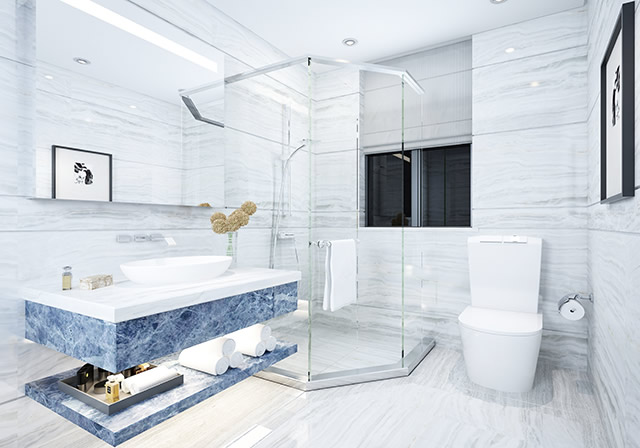
3. Bathroom fixtures quality, including checking for cracks in toilets, bathtubs, sinks, and other fixtures, as well as checking for leaks in bathtubs, toilets, and sinks. Pay close attention to cracks, which may be as thin as hair; when inspecting toilets, check if the water drains smoothly, if the flushing sound is normal, and if there are any leaks in the toilet tank. Also, check the waterproofing at the joints between bathtubs, sinks, and walls or cabinets.
4. Wall treatment is also crucial. In typical bathroom waterproofing, a waterproof coating should be applied on the walls, approximately 30 centimeters in height, to prevent water from penetrating. However, if the bathroom walls are non-load-bearing, lightweight walls, the entire wall surface should be fully coated with a waterproof coating.
5、After the customized sanitary room floor surface is completed, a second water cutoff test should be performed. The water cutoff period should not be less than 24 hours. The test is considered successful if there is no leakage or moisture observed in areas such as under the floor, around wall corners, and near pipes. A water cutoff test record should be filled out, and the waterproofing work should be accepted according to the established procedures.
II. Bathroom Customization Acceptance Standards
(1) Wall, floor, and tile acceptance
First, check that the wall surface has no prominent or recessed bricks, and that the joints between the bricks are straight and uniform. Feel: The surface should be smooth and even. Tap: Gently tap the bricks with a screwdriver handle, and listen for hollow sounds, especially at the corners of the bricks and around bathtubs and sinks.
1、Pay attention to whether there is any water accumulation in the bathtub.
2、 Drain all water and inspect the drainage pipes for any blockages.
3. based on this, continue adding water and check if the overflow outlet is clear.
4. Check if the water level has decreased after filling the overflow drains of the bathtub and sink. If the water level has decreased, it indicates a leak.
(2) Ground Acceptance
The owner can pour a bucket of water on the ground and observe whether it flows towards the drain. If the water does not flow or accumulates in a large area, it indicates a problem with the ground construction. This method can also be used to check the bathroom waterproofing. If the occupants of the lower floor report a leak, the ground will need to be re-constructed. Pour a few buckets of water into the drain and check if the pipes are clear.
(iii) Toilet inspection
Use silicone at the joint between the toilet and the floor tiles. Using white cement is incorrect.
(IV) Acceptance of Drainage System
Regarding potential water leakage issues in custom bathrooms:If water leakage is detected, and the upper bathroom is in use, the lower bathroom could be affected by small amounts of water. A thorough water test, which can be time-consuming, may require removing all existing floor tiles in the affected area and completely re-applying waterproofing before reinstalling the tiles and re-testing.