
One, wall-mounted washing water tank
Wall-mounted washing tanks are designed to hang the tank on the wall. They are categorized into pressurized and non-pressurized tanks. Non-pressurized tanks can be further divided into high-position and low-position washing tanks. Pressurized tanks are typically closed metal water tanks with internal water pressure equal to the pressure in the pipes. During washing, the water is discharged at a pressure close to the pipe pressure, so the washing effect is determined by the pipe pressure.
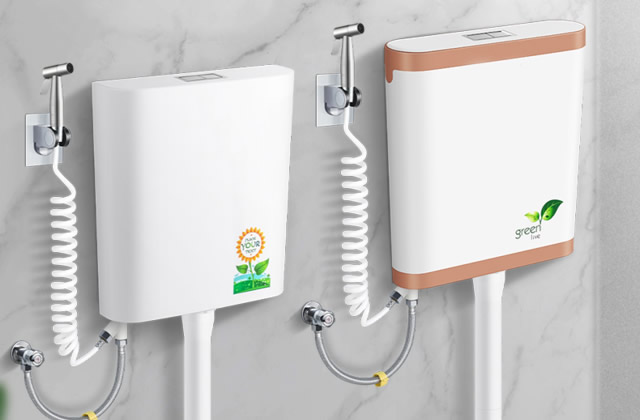
High-level waste disposal tanks are typically located on the top of a room, usually around 2 meters high, and require wiring. They are now rarely seen, and during flushing, they convert the potential energy of the water in the tank into kinetic energy for flushing. With a small amount of water, good flushing effects can be achieved. However, the disadvantage is that they are located too high, which poses safety risks, makes installation and maintenance difficult, and is not aesthetically pleasing.
Currently, low-level flushing tanks are widely used. Low-level flushing tanks are easy to install, use, and maintain, with good washing performance and small water flow (3 liters per flush forUrinate, 6 liters per flush for Stool), suitable water pressure from 0.5 kg to 16 kg, and storage tank capacity typically ranges from 6 to 12 liters.
Two. Integrated Washing Water Tank
In essence, it's a washing tank that combines a plastic inner container with a ceramic container. This type of tank is now relatively uncommon.
III. Concealed Drainage Tank
A concealed flush-mounted water tank is a type of water tank that incorporates the tank and related accessories within the wall structure. Its structural principles and functions are similar to those of a standard water tank. However, due to its partial or complete embedding within the wall, it offers advantages such as improved aesthetics, space-saving design, easier cleaning, but requires thicker walls, more complex installation, and less convenient maintenance.
Due to its compatibility with both squat toilets and wall-mounted toilets, it offers greater space-saving benefits compared to traditional seat toilets, making it a popular choice internationally. Domestic users are also increasingly adopting this type of toilet.
IV. Mechanical Flushing Tank
Typically refers to washing tanks that require manual operation, which are semi-automatic washing tanks in contrast to non-contact washing tanks, such as low tanks, high tanks, and concealed tanks.
Five. Non-contact flushing tank
Non-contact flushing systems primarily refer to smart flushing systems and liquid-controlled flushing systems. Smart flushing systems typically consist of infrared-sensing flushing systems, which enhance existing low-flush systems by adding infrared sensing devices. These systems may incorporate mechanical or electronic switches, such as those installed on toilet doors, to control flushing automatically using a chip. They can differentiate between solid and liquid waste, making them popular in high-end settings.