
One, do large core panels need to be straightened?
Generally, this is not required.
Plywood boards offer excellent screw-holding capacity and high strength, with characteristics such as solid structure, sound absorption, and insulation. They also have a low moisture content (10%-13%), making them easy to work with. They are widely used in furniture, doors, windows, partitions, false walls, radiators, and curtain boxes.
Of course, whether or not to use a straightening tool for large ceiling panels primarily depends on the finished large ceiling panel itself. For example, if large ceiling panels are used to make wardrobe doors, it is recommended to use a straightening tool if the doors are too high, as this will better protect the use of the wardrobe doors.
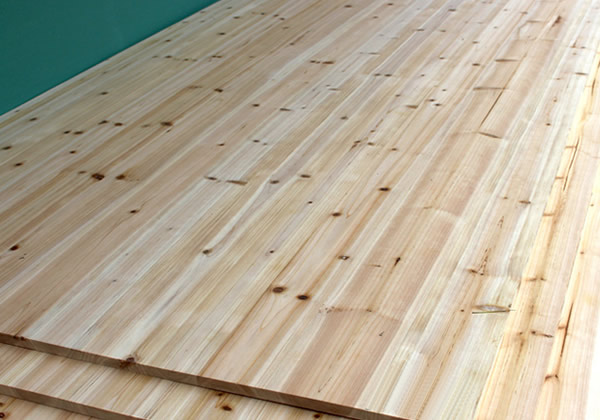
If the standard ceiling panel is a finished product with a height not exceeding 2.4 meters, a straightener is not required. This is because standard ceiling panels have inherent characteristics of high strength and quality, making them less prone to deformation, and therefore, additional straighteners are not necessary for support.
Two. Will the large core board warp?
- Non-deformable.
Plywood is a special type of plywood produced on the basis of particleboard manufacturing, using wood strips or hollow panels as core panels, and covering two or more layers of plywood on both sides, which are then pressed into a finished product. The boards are held together with a certain degree of balance, making them less prone to deformation.
The types of plywood available include, but are not limited to, poplar, birch, pine, and toon. Of these, poplar and birch are considered the best due to their dense, non-brittle, and strong wood properties, as well as their resistance to deformation.
The large-sized CLT panels assembled on-site experience significant compressive stress, with minimal gaps, smooth joints, and uniform load distribution. This results in a compact structure that is resistant to deformation over the long term.