
One. Large core board
Plywood, also known as veneer plywood or timber plywood, is a type of plywood produced by bonding together thin wood strips or hollow core panels, and then covering both sides with one or more layers of plywood.
Thin plywood has excellent screw-holding capacity, high strength, and features such as hardness, sound absorption, and thermal insulation. It also has a low moisture content, typically between 10% and 13%, making it easy to process and widely applicable.
- Commonly used in furniture manufacturing, sewing machine tables, vehicle interiors, and shipbuilding, as well as in the construction industry.
Two. Multi-layer solid wood panels
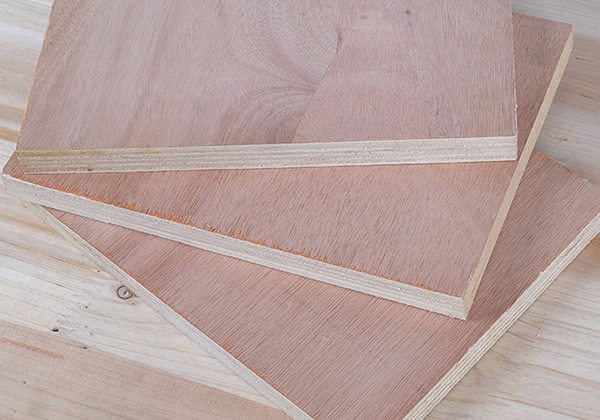
Multi-layer solid wood panels are manufactured by hot pressing three or more layers of solid wood panels or thin wood panels with wood adhesive. Plywood is generally divided into six specifications: 3mm, 5mm, 9mm, 12mm, 15mm, and 18mm.
Multi-layer plywood is compared to standard market plywood, exhibiting minimal warping, high strength, excellent internal quality, and good flatness. It can be produced in thicknesses ranging from 5-40mm. Multi-layer solid wood panels utilize multi-layer plywood with interlaced longitudinal and transverse orientations as the substrate. The surface is made from high-quality solid wood veneer or engineered wood, and is manufactured through several processes including cold pressing, hot pressing, sanding, and curing.
Due to the inherent stability and excellent thermal and humidity regulation properties of multi-layer solid wood panels, as well as the natural and authentic wood texture and feel of veneered solid wood panels, the selection is more flexible.
Multi-layer solid wood boards have good structural stability and are resistant to deformation. Through the combination of longitudinal and transverse bonding and high-temperature, high-pressure processes, internal stress-related deformation issues of solid wood boards are resolved. During production, high-quality, environmentally friendly adhesives are used, ensuring that the product's formaldehyde emission meets national standards, making it environmentally friendly.
Three. Should large-core board or multi-layer solid wood board be used for cabinet construction?
Plywood is a special type of plywood, and its production follows the principle of symmetry to prevent warping and deformation. It overcomes the heterogeneity of natural wood, resulting in uniform and stable properties and shape, making it a suitable alternative to solid wood. Although plywood also contains free formaldehyde, it uses less glue, and its environmental performance is far superior to particleboard and MDF, making it a high-quality flooring material.
Multi-layer solid wood planks, arranged in a cross-grain pattern, exhibit minimal differences in their physical and mechanical properties in the longitudinal and transverse directions, resulting in high structural strength, good load-bearing capacity, excellent moisture resistance, and resistance to deformation. These advantages are superior to those of plywood. However, plywood uses less adhesive and has a higher environmental rating, along with advantages such as light weight, strong vertical load-bearing capacity, lower investment costs, and lower prices.