
One, will wooden boards expand and contract with temperature changes?
Yes, but the issue is not a major problem.
Generally, wood products exhibit thermal expansion and contraction.
The manufacturing process for plywood requires stringent conditions, including ample space for the wood to dry naturally and uniformly, as well as precise control over the drying process within a drying chamber.
- Particularly, engineered wood panels are subjected to high compressive forces due to their precision assembly, resulting in minimal gaps, smooth joints, and even load distribution. This ensures long-term stability and structural integrity, with a compact design that minimizes deformation.
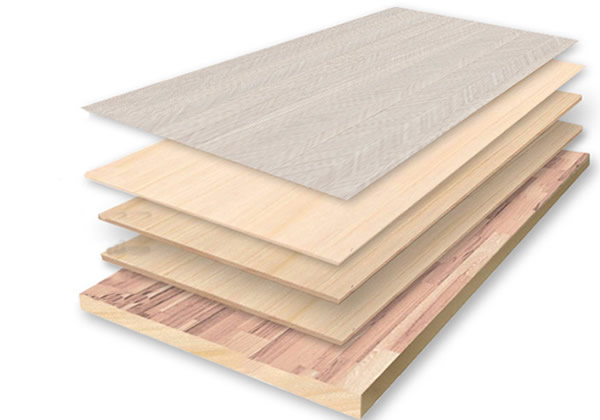
However, wood-based panels are susceptible to moisture, and some boards may have issues such as uneven drying, gaps between layers, and warping or delamination due to expansion and contraction. These issues can also lead to peeling and detachment. Therefore, it is important to avoid using these panels in wet environments like kitchens and bathrooms during construction.
Two. Will the wood panels warp?
Non-deformable.
Plywood is a special type of plywood produced based on the production of particleboard, using wood strips or hollow core boards as the core, and covering two or more layers of plywood on both sides, which are then compressed with glue to form a composite board. The board is held together by balanced pressure between the boards, making it less prone to deformation.
The types of wood used for plywood include, but are not limited to, willow, birch, pine, and toon. Willow and birch are preferred due to their dense, firm texture, strong nail holding capacity, and resistance to deformation.
The manufacturing processes for plywood are divided into machine-cut and hand-cut methods. Machine-cut plywood experiences higher compression, with minimal gaps and smooth joints, resulting in uniform load-bearing capacity, a compact structure, and resistance to deformation over the long term.