
One, what are the specifications for anti-theft door locks?
1、Grade A lock
Currently, the A-grade split keys and cross keys available on the market have a relatively simple internal structure for the A-grade lock cylinder, with only variations in the pins. The pin slots are few and shallow, resulting in a locking time of less than 1 minute and a very high key duplication rate.
2、Level B lock
B-grade lock keys belong to flat keys. The key difference between B-grade locks and A-grade locks is that the B-grade keys have an additional row of curved, irregular lines on the key face. The types of lock cores are divided into 3 categories: computer double-row lock core, crescent-shaped double-row lock core, and double-sided leaf lock core.
3、Super B-grade locking
The lock features a single-sided blade with milled grooves, and employs a side-pin lock mechanism. It has undergone 270-minute testing by the Public Security Bureau and is technologically uncrackable. The spring mechanism utilizes double-row blades and V-shaped side pins for locking.
Two. Internal structure diagram of the anti-theft lock core
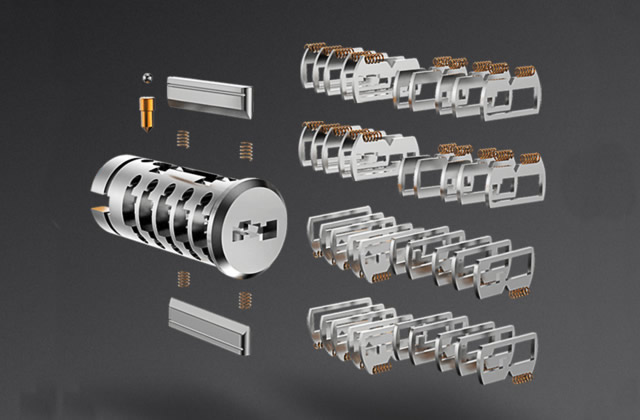
1、4 corner columns
A standard lock typically has only two side posts, which do not provide strong anti-theft protection. In contrast, anti-theft door locks usually consist of four counterweight side posts, offering excellent anti-theft performance and making them very difficult to break open.
2、40 leaves
The lock features 40 individual leaves. The more leaves used, the greater the number of possible unlocking positions, making it more difficult to open and enhancing its anti-theft performance.
3、6-story duplex technology
Utilizing the principle of "structural mechanics," a double-sided, six-layer, reciprocating track synchronization mechanism locks the four corner posts of a rectangular frame, with the reciprocating track's 40 blades maintaining balance. This effectively prevents unauthorized individuals from using tools like wire cutters or drills to open the lock.