
I.Anti-theft door lock coreWhat is the structure?
1、The locking mechanism consists of three parts: the lock body, the central housing, and the outer shell.
2. The lock mechanism features numerous slots, each containing a leaf and a spring that pushes the leaf. A notch corresponding to the keyway is present on the leaf, along with an operating pin.
3. Inside the main shell, a slot will be created that corresponds to the notch on the locking leaf, and it will still contain a movable pin.
4. A slot will be present on the inner wall of the housing, corresponding to the opening in the intermediate shell. The active pin within this slot is designed to return to its original position.
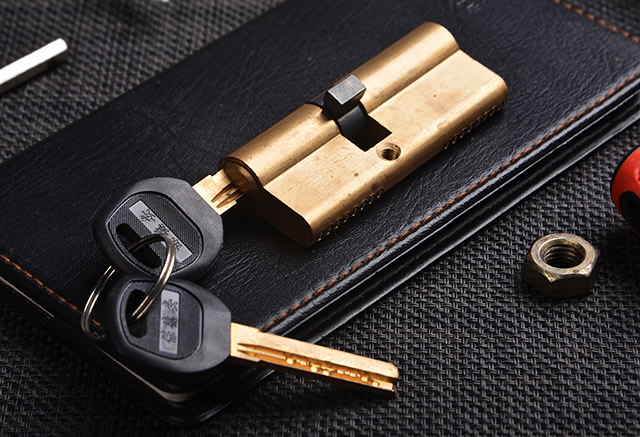
From the above structure, it can be seen that the lock core of the anti-theft lock consists of a cyclical process, starting from the lock head, passing through the central shell, and finally reaching the outer shell. After opening the lock with the lock head, the operating pin is rotated to engage with the teeth, allowing the handle to rotate normally. The spring in the outer shell then returns the operating pin to its original position.
Two. Principle of opening the anti-theft door lock
Lock mechanisms vary, and anti-theft door locks can be categorized as: spring-loaded locks, leaf locks, magnetic locks, IC card locks, and fingerprint locks, among others.
1、Ball lock and magnetic locks are commonly used. Locks such as one-way locks, cross locks, and computer locks fall into the category of ball locks. Magnetic locks were popular a few years ago, but are now less common. If the key has a smooth stem with three or four small holes, it is a magnetic lock. Industry experts believe that magnetic locks are not very secure, while cross locks are easy to open. Specialized tools for opening magnetic locks and cross locks are now available on the market. With these tools, thieves can open most magnetic locks and cross locks in a matter of minutes.
2. Computer locks are more secure, and "computer lock" is simply a professional term. Computer locks are not actually opened using computers. Computer lock keys have three to five differently sized circular notches – these notches are supposedly created by the manufacturer using computer software, hence the name "computer lock."
3. Another type of robust security lock is the composite lock. A composite lock refers to the combination of two or more different locking mechanisms. The most common composite lock on the market is the combination of a spring-based lock and a magnetic lock, which is also known as a magnetic composite lock. To open this type of lock, you first need to disrupt the lock's magnetic properties, and then use specialized techniques to open it. However, magnetic composite locks have a fatal weakness: if the key is not properly stored, exposed to strong impacts, or subjected to high temperatures, the magnetism will be lost. once the magnetism is lost, the lock will no longer open.