
One. What are the functions of a multi-functional learning desk?
1、Curved desk support: The curved design allows the child to connect with the desk, promoting proper posture while ensuring that both elbows are comfortably supported by the desk.
2、Suitable for writing on sloped desktops: According to the "perspective" principle in visual theory, the desktop should have a slope of approximately 15 degrees downwards, allowing children to avoid bending their heads.
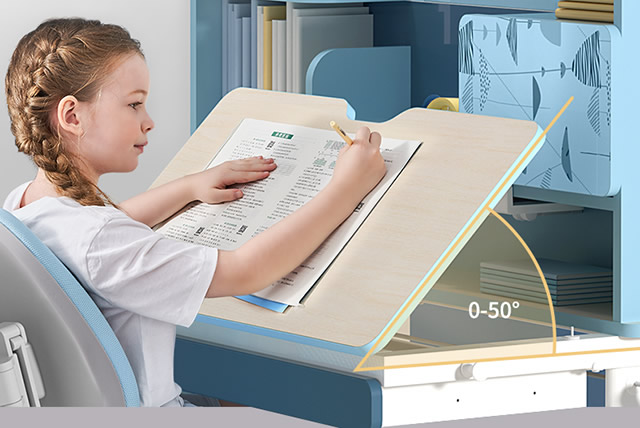
3、Convenient Bookstand: The bookstand is positioned directly in front of the workbook, ensuring a distance of 30cm to 50cm between the book and the user's eyes. This 20cm adjustment allows for a shift between looking far and looking near, relaxing the ciliary muscles and preventing eye fatigue from continuous 2-hour writing, thereby preventing myopia.
4、Adjustable Height: Different ages and heights require different desk heights. The Cisco learning table features adjustable height settings, ensuring suitability for children of all ages and sizes.
5、Environmentally Friendly Materials: The children's learning table utilizes medium-density board that meets European environmental standards, combined with rice-nano veneer. The edge banding uses drinking water-grade PVC, ensuring safety and non-toxicity.
6. Storage: The learning desk features multiple storage areas to encourage children to develop good self-organizing habits, while also keeping the desk surface clean and spacious. With ample storage, indoor spaces can become a child's personal treasure trove, filled with countless hidden items.
Two, what are the differences between multifunctional desks and traditional desks?
The key difference between multifunctional learning desks and traditional desks and chairs lies in their design, which integrates principles from ergonomics, human mechanics, and human physiology. This allows for dynamic adjustments to both the desk height and the angle of the desktop to match the child's individual needs and promote optimal posture for different learning activities.