
One、What adhesive is used for plywood?
based on the composition of the adhesive, the following types of adhesives are used for construction plywood:
Urea-formaldehyde adhesive: Moisture-resistant adhesive/for interior decoration and furniture, not for outdoor use.
Melamine resin: Provides moisture resistance and certain water and weather resistance. Suitable for both indoor and outdoor use, but should not be frequently exposed to water.
Phenolic adhesive: Excellent moisture resistance, heat resistance, and weather resistance. Suitable for both indoor and outdoor applications, and can withstand outdoor wind and rain.
II. Plywood Manufacturing Process Flow
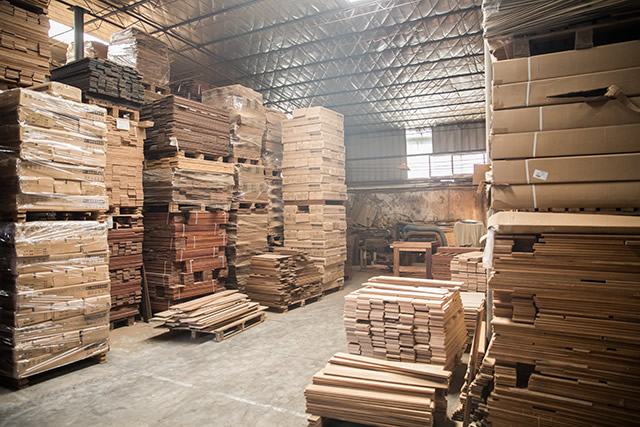
(1) Process flow for producing wood-based plywood from raw timber: Raw timber → Timber sawing → Steaming and drying of timber → Debarking of timber → Veneer cutting → Veneer drying → Veneer sorting and grading → Glue-up → Pre-pressing → Hot pressing → Edge trimming → Final cutting → Inspection and grading → Packaging and storage.
(Two) Process flow for producing plywood:Plywood sorting → Coating and assembling → Pre-pressing → Heat pressing → Cutting → Sanding → Inspection and grading → Packaging and storage.
1、Processing losses:During the entire production process of plywood, factors such as sawing, slicing, drying, and finishing of the original timber, as well as lamination, trimming, and cutting affect the overall waste. This waste can be categorized into tangible waste (waste resulting from processing) and intangible waste (shrinkage and compression). The amount of waste is influenced by factors such as the type and dimensions of the original timber, the condition of the equipment, the processing techniques, and the final plywood specifications.
2、Original timber sawing:imported solid wood typically exceeds 6 meters and should be cut according to the required length and quality specifications. The resulting wood segments should be the length of the finished plywood dimensions plus any necessary processing allowance. For example, a finished plywood sheet with dimensions of 1220mm x 2440mm, the wood segments typically measure 2600mm or 1300mm. The length of the solid wood and its curvature, defects, etc., directly affect the yield of the plywood. The resulting waste includes small wood segments, cut ends, and sawdust. The wood cutting loss rate for solid wood is generally between 3% and 10%.
3、Single-plate cutting:The most widely used method for producing plywood is the rotary cutting method, resulting in single-layer panels with a thickness of approximately 0.6mm for the face and back layers, and approximately 1.8mm for the core and intermediate layers. This process has the highest waste due to: one, the irregular shape of the wood segments, which renders a significant portion of the cut segments unusable; two, the clamping of the wood segments at both ends by the rotary cutting machine, resulting in end-segment waste; and three, the waste from the wood core. The waste generated from rotary cutting of single-layer plywood consists of cut segments and wood core, indicating that the waste rate is related to the material, diameter, and performance of the wood segments and the equipment. This waste rate ranges from 15% to 25%.
4、Single-layer drying:After being sliced, the solid wood panels have a high moisture content and must be dried to meet the requirements of the gluing process. After drying, the wood shrinks in size, a phenomenon known as "drying shrinkage." This shrinkage affects the length, width, and thickness of the solid wood panels due to the reduction in moisture content. The extent of drying shrinkage depends on factors such as the type of wood, the initial moisture content of the solid wood panel, and the thickness of the solid wood panel. The typical drying shrinkage rate ranges from 4% to 10%.
5、Single-sided surface preparation:The preparation of individual boards includes cutting, assembling, and repair. Dry, strip-shaped boards and individual pieces are cut into standard and joinable boards. Narrow strips are assembled into full boards. Defective full boards can be repaired to meet the quality requirements. The amount of waste boards generated in this process depends on factors such as the original wood material, the quality of the sawed boards, the quality of the dried boards, and the familiarity of the operators with the board standards. The waste rate is generally 4% to 16%. In the process of directly processing individual boards into plywood, the waste rate is generally 2% to 11%.
6、Hot pressing:Securely bond the pre-glued sheet metal blanks together using a specific temperature and pressure. During hot pressing, the wood gradually compresses as the sheet metal blanks' temperature and moisture content change, resulting in a gradual reduction in the sheet metal blank thickness. This loss is due to compression and is influenced by factors such as the hot pressing temperature, pressure, pressing time, wood species, and moisture content of the sheet metal blanks, with a typical loss rate of 3% to 8%.
7、Trimming:Cut the pressed particleboard into standard panel sizes. The amount of waste generated from cutting the particleboard depends on the panel size and the trimming allowance for the plywood. The larger the plywood size, the lower the waste rate, which is typically 6% to 9%.
8、Sanding:Sand the plywood surface to achieve a smooth and aesthetically pleasing finish. The waste generated by this process is sanding dust. When the plywood quality is good, the amount of sanding required is minimal, and the sanding loss rate is typically 2% to 6%.