
One, Advantages and Disadvantages of Plywood
Plywood offers excellent screw-holding strength, high durability, and features such as stiffness, sound absorption, and thermal insulation. Plywood has a low moisture content, typically between 10% and 13%, and is easy to work with. It is widely used in furniture, doors, windows, partitions, false walls, radiators, and curtain boxes.
Due to its construction with solid wood strips, plywood requires minimal equipment and is easy to install on-site.
However, particleboard uses a large amount of urea-formaldehyde resin during production, resulting in a generally high formaldehyde emission level. This is also due to the fact that environmental standards are generally low. Many particleboard manufacturers use substandard materials and create large gaps when joining solid wood strips, resulting in voids within the boards. Nails driven into these gaps will have very little holding power. The solid wood strips within the particleboard are oriented vertically, which reduces the board's bending resistance. Over time, this can cause noticeable horizontal deformation of the boards.
II. Advantages and Disadvantages of Particleboard
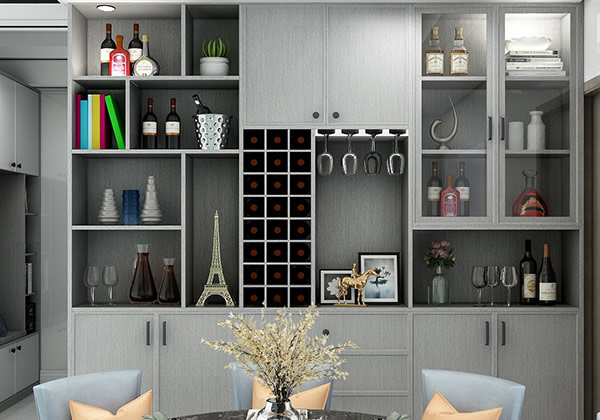
- Enhanced decorative performance: The surface of particleboard is smooth and fine, with no knots, insect holes, warping, or cracking. It has high physical and mechanical strength, equal strength in both vertical and horizontal directions, sound insulation, mildew resistance, cost-effectiveness, and thermal insulation properties. It is more aesthetically pleasing than other types of wood.
Low deformation: Engineered wood particle board exhibits minimal deformation and excellent dimensional stability, high strength, and good stiffness, making it suitable for hanging heavy items without bending. The primary engineered wood panel used in the European furniture market is also engineered wood particle board.
Strong nailing performance: The internal structure of the particleboard consists of cross-laid, granular wood particles. This results in strong nailing performance, allowing for the use of round nails and screws. These properties are significantly better than those of medium-density fiberboard (MDF), but still have some gaps compared to solid wood furniture.
- Excellent processing performance: The density of particleboard is similar to that of solid wood, and it has excellent physical and mechanical properties. It is the most similar to natural wood among all types of engineered wood and even outperforms natural wood in some aspects. Therefore, it has excellent processing performance and can be processed using the same methods and equipment used for processing solid wood. The internal structure of the particleboard consists of cross-arranged wood particles, which are arranged in a specific direction. Its superior bending strength in the longitudinal direction compared to the transverse direction, along with its ability to be sawn, sanded, planed, drilled, nailed, and filed, make it a suitable material for the furniture industry.
However, the processing of particleboard involves the use of glue, which results in slightly lower environmental performance compared to solid wood; the surface is not smooth; solid wood particleboard has lower flatness than MDF, making it difficult to create curves and shapes.
Three. Which is better, plywood or particleboard?
Plywood and particleboard each have their own advantages and disadvantages. Regarding their environmental properties, specifically formaldehyde emissions, plywood generally has lower formaldehyde content than particleboard. However, most boards currently use soy-based and plant-based adhesives, and the formaldehyde emissions from these boards can generally be controlled to E0 level. Therefore, whether plywood or particleboard is better depends on individual needs and preferences.